The importance of remote reading and network infrastructure in water management
Blog
Posted on 06.03.2026
Drinking water management is now a major challenge for local authorities, at the crossroads of environmental, economic and health imperatives. Faced with climate change, increasing scarcity of resources and ageing infrastructure, it is becoming essential to better understand, measure and control water consumption.
Remote meter reading is emerging as a key lever: it enables more accurate monitoring of usage, early detection of leaks, improved network efficiency and better information for users. However, its large-scale deployment still faces numerous technical and operational constraints.
Remote meter reading involves equipping the water meter with a module that allows the transmission of the consumption index to a secure internet platform, via a network of equipment located mainly on public land (radio antennas and repeaters in certain areas).
Technical issues encountered by water stakeholders
Water unions and public service contractors face structural difficulties in implementing remote meter reading. Most meters are buried underground, often in damp and confined environments, which significantly degrades radio transmission quality.
Our technical solutions are designed for LoRa and Wize Alliance network operators operating in challenging environments, particularly where there are significant geographical constraints: vast rural areas, isolated hamlets, rugged terrain, or regions lacking digital and energy infrastructure. In such contexts, radio coverage can become intermittent or non-existent, limiting the reliability of the data collected.
Finally, the lack of power supply at many sites complicates the installation of communication gateways, sometimes forcing operators to abandon remote meter reading or to maintain costly and inefficient manual readings.
PowerBox TETRADIS: ensuring energy independence and continuity of remote meter reading
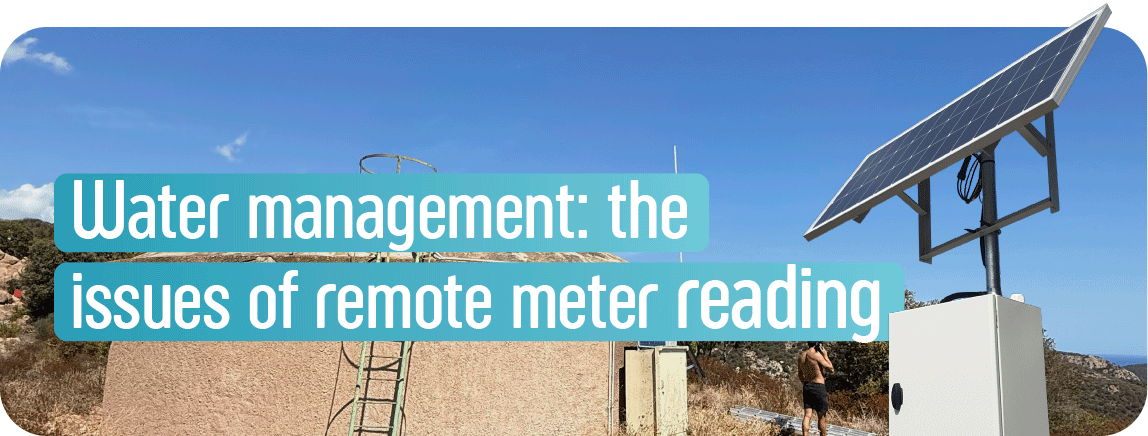
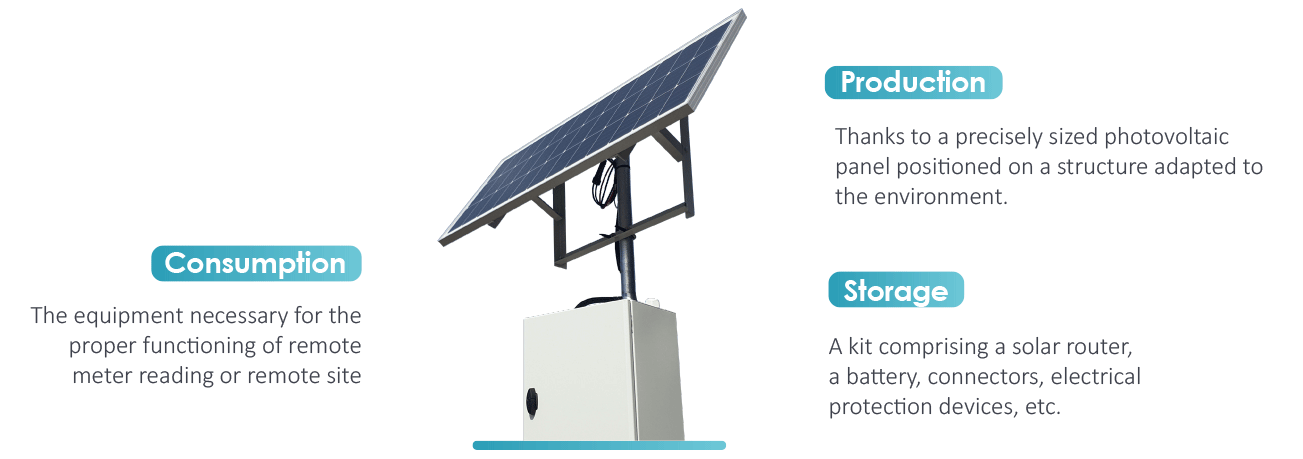
To overcome the energy access constraints that are still hindering the roll-out of remote meter reading, TETRADIS has designed the PowerBox, a power supply solution dedicated to LoRa gateways. It is based on photovoltaic technology, enabling the energy required to operate communication equipment to be produced locally. This production is supplemented by an integrated storage solution, ensuring sustainable energy autonomy and continuity of service, even in the absence of sunlight.
Thanks to this architecture, the PowerBox allows LoRa gateways to be installed in isolated areas without connection to the electricity grid, while ensuring reliable and continuous transmission of remote meter reading data. It thus offers local authorities and operators a concrete solution to radio coverage and power supply issues, making remote meter reading possible where it was not previously available.
This solution also fully meets the remote management needs of sensitive infrastructure, particularly for strategic water management sites. The PowerBox can therefore power SOFREL-type remote management modules. It is also possible to combine remote meter reading and remote management within a single autonomous cabinet, offering a unique, centralised solution that meets the availability and service continuity requirements of local authorities and operators.
Discover the case of one of our clients
• Client: SUEZ National Water Supplier
• Location: Water Authority for the Monts du Lyonnais and Lower Gier Valley in the departments of the Loire and the Rhône
• Objective: To provide a solution in the absence of electricity
As part of the roll-out of a remote water meter reading infrastructure, a self-contained power supply solution was implemented to enable the installation of Wize Alliance IoT antennas in areas without mains power. The project involved designing a self-contained, solar-powered enclosure, incorporating electrical protection, a battery, a solar regulator and a voltage converter, to house the communication equipment supplied by the client.
One of the main advantages of this solution is its modular architecture: the various modules (solar power generation, storage, electronics and IoT equipment) can be configured and deployed according to the specific constraints of each site. This flexibility facilitates the installation of antennas and allows for the expansion of remote meter reading coverage while ensuring a reliable and completely autonomous power supply.
In conclusion, the solution meets three key objectives: efficiency, simplicity and a reduced environmental footprint.