The city of Lorient combines its charging stations with its solar power generation
Customer projects
Posted on 22.12.2025
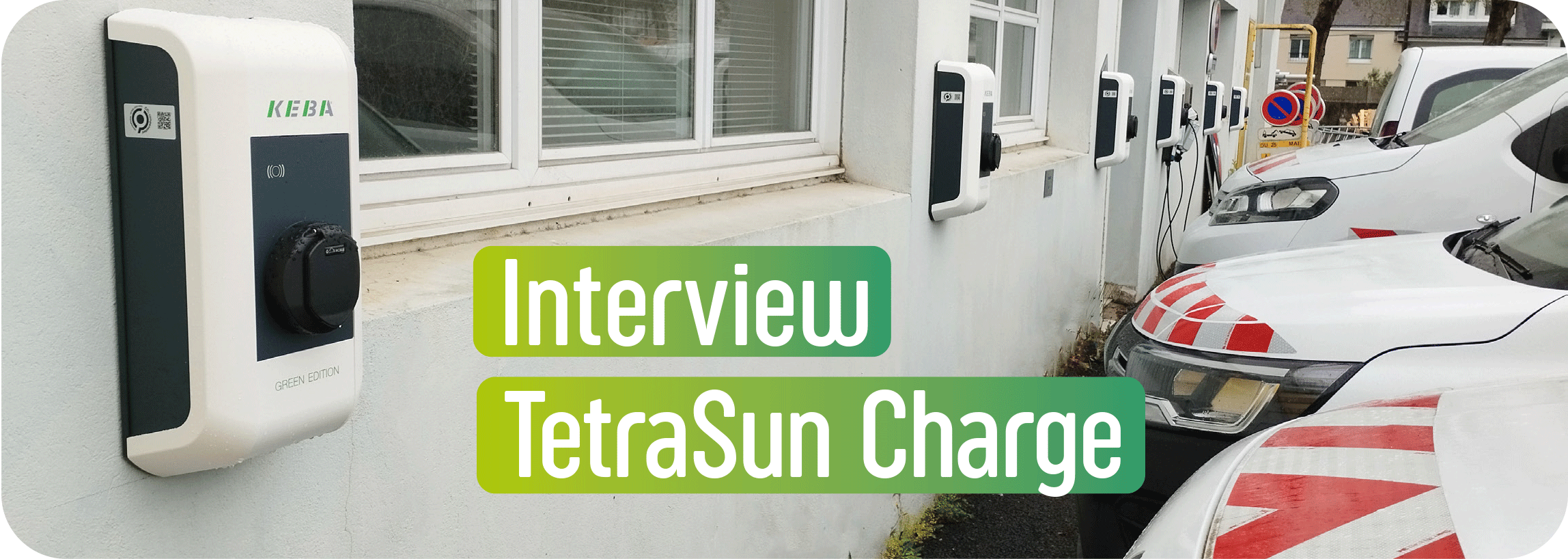
With the simultaneous rise of photovoltaics and electric mobility, the ability to intelligently manage energy is becoming a key issue. TETRADIS wanted to support the market by developing a solution that effectively combines solar production and electric vehicle charging. With TetraSun Charge, TETRADIS makes it possible to significantly increase the rate of self-consumption while effectively supporting the transition to sustainable mobility.
We give the floor to Sébastien Fleury, Energy Equipment Optimisation Manager, to talk to us about the deployment of the TetraSun Charge solution at the Municipal Technical Centre in the city of Lorient.
Testimonial from Sébastien Fleury, responsible for optimising energy equipment in the city of Lorient
What is your position and role within the city of Lorient?
What was the project?
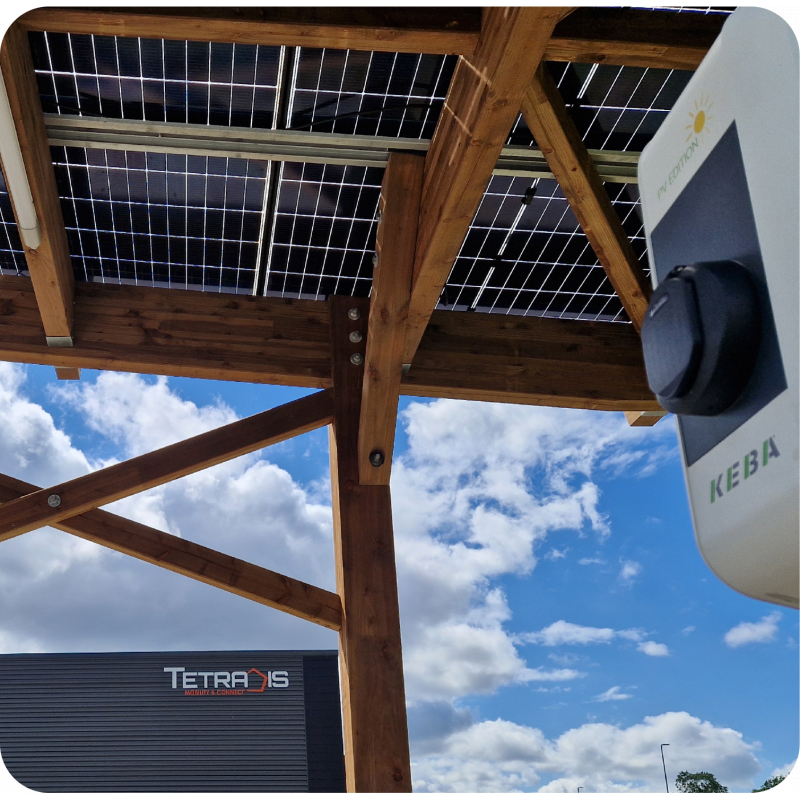
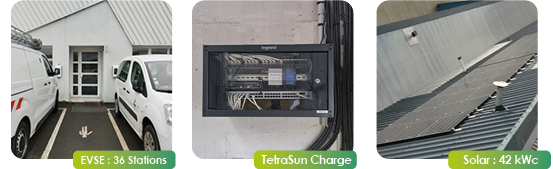
The local authority is taking concrete action by developing photovoltaic production and electric mobility. In 2025, the greening of the vehicle fleet will begin in order to equip all relevant staff with electric vehicles (excluding large vehicles). The Municipal Technical Centre (CTM) site already had two solar power plants operating on a simple self-consumption basis. In this context, surplus production, particularly at weekends, was not being exploited.The project was therefore born out of a desire to install charging stations for electric vehicles capable of harnessing available solar energy in order to reduce electricity consumption from the grid.
What infrastructure was already in place?
What were your requirements and how did TETRADIS meet them?
Our main requirement was to optimise vehicle charging based on surplus photovoltaic energy, prioritising charging when solar power is actually available rather than according to fixed time slots.Our service vehicles are left to recharge by agents every lunchtime and every weekend. We wanted them to be powered exclusively by solar energy whenever the weather permitted. In the event of a lack of recharging due to bad weather, we wanted to be able to use a BOOST mode on Sunday evenings to ensure their availability on Monday mornings.
Working closely with our teams, TETRADIS has developed the solution using TetraSun to automate recharging based on actual surplus production. Today, the system fully meets our expectations: it triggers recharging when there is a photovoltaic surplus and allows us to make the most of the energy produced on site.
Another strong point is that it is a scalable solution: future solar power plants can be integrated naturally, as the system will be able to integrate them automatically.
How did the preliminary design and commissioning go?
We were assisted by a project management consultant in drafting the specifications and studying solar control options. Other solutions were considered, but TETRADIS proved to be the most responsive in adapting to our needs. The integration of TetraSun required adjustments and development, and TETRADIS was able to adapt the interface until the system met our exact expectations:• specific customised development,
• adaptation of the installation,
• successful commissioning,
• remote settings by their technical teams.
The physical installation was quick: the equipment was fully prepared in the workshop, and it took only half a day to deploy thanks to an integrated box that was ready to be plugged in.
What were the highlights of the collaboration with TETRADIS?
Several elements stand out from this collaboration, starting with the adaptability of the TETRADIS teams. The solution was able to evolve in line with our needs, thanks to real development work until a fully satisfactory result was achieved. The network expertise and preparation of the equipment in the workshop also enabled rapid installation without any on-site issues. Finally, the human support, marked by direct exchanges with developers and engineers, enabled us to refine the solution to the highest standard.What can you say after six months of use?
The initial assessment is positive: we are now utilising our photovoltaic energy much more efficiently.Previously, we operated with fixed charging time slots, which sometimes resulted in unwanted grid charging. For example, the vehicle might charge via the grid on Saturday when Sunday was forecast to be sunny and solar power could have been used to charge it.
Today, the system automatically triggers recharging only when there is surplus solar energy available. We estimate that approximately 25% of the photovoltaic energy is used to power recharging, mainly at weekends and between 12 noon and 2 pm. The solution has increased flexibility, as the system operates independently and I can activate a ‘boost’ mode on an ad hoc basis if an agent needs to recharge urgently.
The solution will continue to improve as we add new solar power plants.
Universal compatibility, a major advantage recognised in the field!
One of TetraSun Charge's major strengths, highlighted in particular by Sébastien Fleury, is its universal compatibility. The solution is designed to integrate easily with all photovoltaic installations on the market, without technological constraints or dependence on specific equipment. It is suitable for both small-scale projects and larger infrastructures, ranging from 1 to several dozen charging stations, in both residential and professional environments. Its proven compatibility with recognised terminal brands such as Keba and Wellborne, as well as its openness to any communicating terminal, guarantees great freedom of choice and sustainable scalability of installations. This open and pragmatic approach facilitates deployment, secures investments and enables local authorities and businesses to upgrade their equipment in line with their energy and mobility needs.
TetraSun Charge is making headlines in the press
TECSOL - TetraSun Charge : Tetradis couple énergie solaire et mobilitéL'ESSOR - Comment Tetradis optimise l'autoconsommation d'énergie solaire
LES AFFICHES - Tetradis mise sur le couplage entre solaire et mobilité